
Who Verified the Verifiers in California’s Elections?
By Christine Bish | The Bish Report
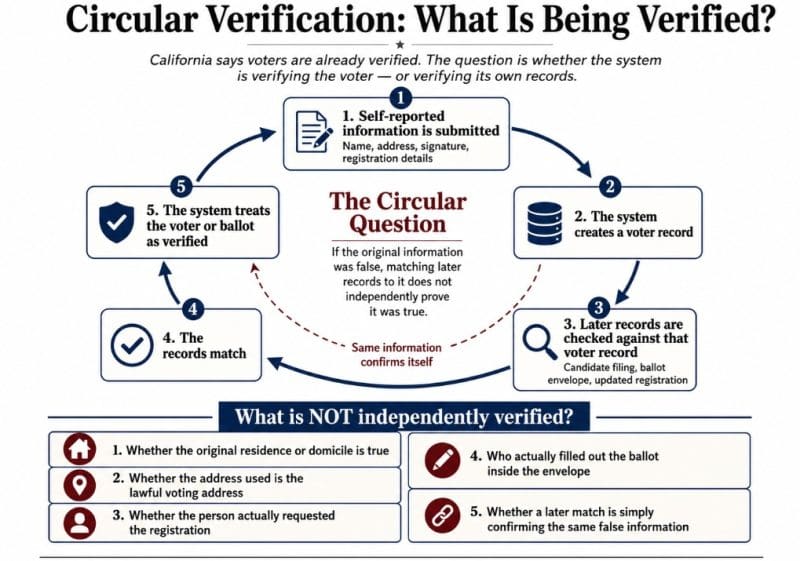
California’s word “verified” deserves scrutiny. California’s own convictions and open prosecutions show that records can match while the underlying residence, registration, or eligibility is false or disputed.
But who built, administered, inherited, and is now defending the California statewide system?
The answer runs through some of the most powerful political figures in California: Alex Padilla, Xavier Becerra, Shirley Weber, Rob Bonta—and now Adam Schiff.
Padilla and Schiff brought that responsibility chain into the present on August 19 when they asked Weber to exercise “maximum oversight” over Shasta County’s election operations.
Before California demands maximum oversight of Shasta, it should explain the oversight record of the statewide system itself.
Padilla Did Not Simply Inherit VoteCal. He Certified It.
Alex Padilla became California Secretary of State in 2015. VoteCal became the statewide voter-registration system connecting the Secretary of State with all 58 counties.
California’s own federal election report states that all 58 counties were live on VoteCal by March 2016. On September 26, 2016, Padilla’s office declared VoteCal the system of record for voter registration in California and certified compliance to the federal Election Assistance Commission.
That makes Padilla central to this story. He is not merely a senator commenting on someone else’s election architecture. He administered the statewide system during its critical implementation years and formally certified it.
Riverside Raised an Early Warning
The warning signs were already appearing.
After California’s June 2016 primary, Riverside County District Attorney Michael Hestrin said his investigation concluded that voter-registration information had been accessed through the Secretary of State’s online system and that some voters’ party affiliations were changed. Hestrin said investigators could not identify who was responsible because the State had not retained the IP-address information needed to trace the activity.
Padilla’s office disputed that this established a breach of the statewide voter-registration database. That dispute matters. What is not disputed is that voters reported unauthorized changes, Riverside investigated them, and the investigation dead-ended at the state level without the technical trail needed to identify a perpetrator.
That was not proof of altered vote totals. It was proof that an election-registration problem reached the State and remained unresolved.
Then California Expanded Motor Voter
California launched automatic DMV voter registration in 2018.
The official Los Angeles County Registrar report from October 2018 documented significant DMV registration errors. It described roughly 23,000 impacted customers from one error, another approximately 1,500 customers potentially registered in error from a separate problem, and more than 1,100 records Los Angeles County was instructed to cancel because of DMV-related errors. Some customers who had asked to opt out were nevertheless transmitted for registration.
Those numbers matter because the argument in Shasta today is that the statewide process already provides adequate verification. The history shows that the data pipeline itself produced documented errors requiring county officials to repair records after the State transmitted them.
The State Auditor Was Already Asking for Better Oversight
California’s State Auditor had also warned that Secretary of State oversight of county election offices needed improvement.
In Report 2017-107, the Auditor recommended annual reviews of county election offices, statewide reporting of election-related errors and stronger guidance from the Secretary of State.
The point is not that the audit proved voter fraud. It did not. The point is that independent state auditors were already telling California that the election oversight structure needed stronger controls.
Sacramento Still Had Unfinished Security Questions in 2020
By the 2020 election cycle, Sacramento County’s Civil Grand Jury was examining election-system cybersecurity.
The Grand Jury reported that most recommended protections had either been adopted or were being implemented. But it also said it could not determine when Sacramento’s last external election-system security audit had been performed or what entity had conducted penetration testing.
Again, that is not evidence that votes were changed. It is evidence that critical security and accountability questions remained open as California moved into the 2020 election.
Becerra Signed the Warning
While Padilla administered California elections, Xavier Becerra was Attorney General.
On July 23, 2018, Becerra joined 20 other attorneys general in signing a letter to Congress warning about stolen voter information, penetrated election websites, compromised election vendors and technologically vulnerable election infrastructure.
Becerra’s signature matters because it establishes that California’s Attorney General personally acknowledged the national threat category while California was simultaneously dealing with its own registration-system and oversight problems.
The question from my earlier investigation remains straightforward: what did California DOJ do internally with that knowledge?
California DOJ clearly had the legal capacity to investigate election matters. In 2020, Becerra and Padilla publicly announced an election-integrity investigation involving unofficial Republican ballot drop boxes and described statewide monitoring and investigative activity.
What remains incomplete in the public record is the comparable investigative file showing what California did about Riverside, VoteCal, Motor Voter, the DMV errors and the security questions documented inside California’s own system.
Becerra is no longer merely a former Attorney General. He finished first in California’s June 2026 gubernatorial primary with 28 percent of the vote and is asking Californians to make him governor.
Weber Inherited the System—and Is Defending It Now
Shirley Weber succeeded Padilla as Secretary of State and now operates the statewide system.
In Shasta County, Weber and Attorney General Rob Bonta are defending California’s centralized election structure and arguing that Shasta cannot establish a separate voter-registration system or impose election procedures that conflict with state law.
That legal question belongs to the court. But it is important that California’s current case rests in part on confidence in the statewide structure inherited from the period examined above.
At the Same Time, California Is Fighting DOJ Over Its Voter Rolls
The State is also fighting a separate federal demand for California’s statewide voter-registration records.
The Justice Department sued Weber and California after seeking the statewide voter list and list-maintenance records. DOJ’s complaint asked California to explain issues including missing duplicate-registration data, the large decline in inactive registrations between 2022 and 2024, and registrations cancelled because of noncitizenship. Weber refused the demand for an unredacted electronic list and instead offered access to a version with private identifying information redacted.
California won dismissal in federal district court. DOJ appealed. The Ninth Circuit heard oral argument on May 19, 2026; as of this article’s publication, the appeal remains pending.
The legal dispute includes legitimate federalism, statutory and voter-privacy questions. But politically, the contrast is difficult to miss.
Shasta asks for more local verification: California goes to court. Washington asks to inspect the statewide voter records: California goes to court.
California wants centralized authority. It is far less enthusiastic about outside examination of that centralized system.
Padilla Is Challenging Federal Scrutiny From the Senate
Padilla’s role continued after he left the Secretary of State’s office.
He is now the ranking Democrat on the Senate Rules Committee, which oversees federal elections.
On August 3, Padilla led a letter challenging the Justice Department’s deployment of federal election monitors and warning against federal interference in state and local election administration.
On August 19, he and Schiff then asked Weber to impose “maximum oversight” on Shasta.
Padilla is entitled to raise federalism and voting-rights concerns. But the record creates an unavoidable accountability question: the official who certified California’s statewide voter-registration system is now demanding aggressive oversight of a county while challenging federal scrutiny of election administration.
Adam Schiff Brings His Own Verification Question
Adam Schiff did not build VoteCal. But he is no longer incidental to this story.
Schiff joined Padilla in demanding maximum state oversight of Shasta. At the same time, federal authorities have investigated allegations involving the primary-residence representations associated with Schiff’s Maryland property. Schiff has not been charged and denies wrongdoing.
The evidence I supplied in connection with that investigation includes California voter-registration material involving Adam and Eve Schiff alongside Maryland mortgage records and sworn affidavits identifying the Maryland property as their primary or principal residence.
Those records do not establish criminal guilt. But they present the same factual verification problem Article One examined: when government records conflict on residence, a voter database cannot resolve the truth merely by confirming what address already appears in the voter database.
The senator demanding maximum oversight of Shasta has his own unresolved residency records illustrating why independent verification matters.
This Is the Responsibility Chain
Step back from the individual headlines.
Padilla certified VoteCal.
Riverside produced an unresolved registration-change investigation.
The State Auditor called for stronger election oversight.
Motor Voter generated documented registration errors that counties had to repair.
Sacramento still had unanswered external-audit and penetration-testing questions approaching the 2020 election.
Becerra signed a national warning acknowledging serious threats to voter data and election infrastructure.
Weber inherited the statewide system.
Bonta and Weber are now defending centralized state control in Shasta.
DOJ is separately seeking access to statewide voter-list records, and California is resisting that demand in federal court.
Padilla is challenging federal election scrutiny while demanding stronger state oversight of Shasta.
Schiff has joined him while his own residency documentation remains part of an unresolved federal matter.
And Becerra is running for governor.
This is no longer a history lesson about 2016, 2018 or 2020. It is happening in real time before the November 2026 election.
What I Am—and Am Not—Saying
I am not claiming Padilla, Becerra, Weber, Bonta or Schiff conspired to commit election fraud.
I am not claiming that the documented system failures prove California election totals were altered.
I am saying that California’s political leadership has repeatedly defended the statewide system while the full accountability record behind that system remains incomplete.
In my opinion, that looks like institutional self-protection.
Maybe officials sincerely believe every major weakness was corrected. Maybe the missing records demonstrate exactly that. Then release them.
Open the California File
Article One showed why the word “verified” deserves scrutiny. Article Two shows why the people defending the system should have to produce the record behind it.
Produce the VoteCal security audits and the acceptance, exception and remediation records behind Padilla’s certification.
Produce the Motor Voter launch and error records.
Produce the Riverside referral and transaction trail that investigators needed.
Produce the statewide list-maintenance records now being litigated with DOJ.
Produce the Sacramento security assessments and external-audit history.
Produce the California DOJ record showing what Becerra’s office investigated after he signed the 2018 warning.
Let both sides use discovery. Let them subpoena witnesses and records. Put the responsible officials under oath.
If California’s system works exactly as its defenders say it does, the records should strengthen their case.
If mistakes were made, acknowledge them and fix them.
But California cannot demand maximum trust while providing minimum transparency.
Article One asked: Verified against what?
Article Two asks: Who verified the verifiers?
Selected Sources
- Padilla/Schiff – Aug. 19, 2026 Shasta oversight letter
- California Secretary of State – VoteCal/HAVA 2016 Annual Report
- KQED – Riverside DA investigation into 2016 voter-registration changes
- Los Angeles County Registrar – 2018 Motor Voter errors
- California State Auditor – Report 2017-107
- Sacramento County Grand Jury – Election Security in Sacramento County
- California DOJ – Xavier Becerra 2018 election-security letter
- California DOJ – Shasta Measure B preliminary injunction
- DOJ – United States v. Weber complaint
- DOJ – United States v. Weber appellate brief
- Padilla – Aug. 3, 2026 federal election-monitor letter
- California Secretary of State – June 2026 Primary Statement of Vote
- CBS News – federal Adam Schiff investigation
Author source note: Adam and Eve Schiff residency references are also supported by the author’s evidence packet and materials supplied in connection with the federal investigation.
The obituaries verifies those casting votes for democrats.
All federal funds should end until California stops stealing elections, and stops all the fraud! Newsom illegally passed the End Nick Shirley act. It is unconstitutional, and no federal funds should be given to the state until there is thorough audits, and corrections, to the election system, and the the rampant fraud.