
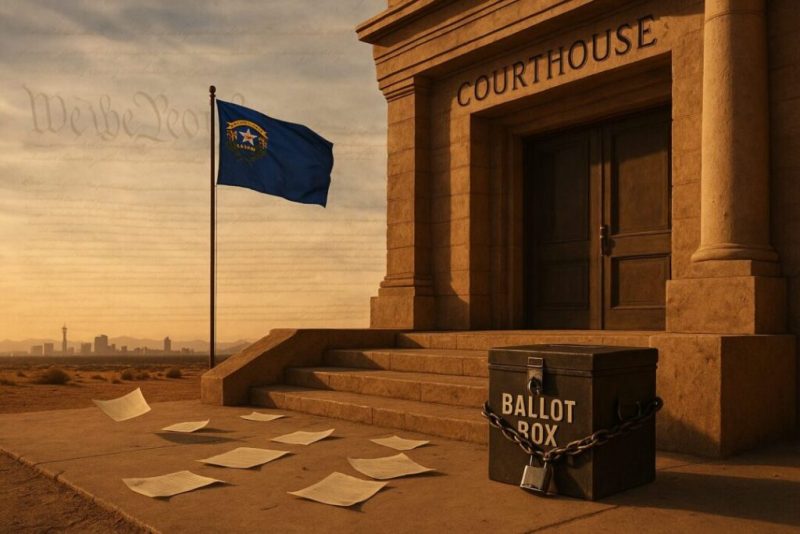
How Nevada’s courts helped Nevada bury and destroy the 2024 election record.
Guest post by Pastor Andy Thompson (picture above from Nevada News and Views)
The Long Train of Abuses
When people are repeatedly told their elections are secure and accurate but are continually denied any real means for proving it, bureaucratic assurance begins to sound a lot less like confidence earned and a whole lot more like compliance commanded.
Such is the condition this record describes.
It does not describe one mistaken ruling or just one procedural setback. It describes a pattern in which election‑related evidence is placed at risk, preservation is raised but never imposed, and delay is applied, allowing risks to ripen without quarantine. The resulting loss and narrowing of proof is then used against the citizen seeking review.
The pattern is not hidden; it is evident in the sequence.
Assurances suffice where orders should stand. Risks trigger resistance and never alarm, and that from the very institutions charged with mitigating them. The legal paths that are said to provide for review of controversy remain available in theory while becoming meaningless in practice, like being allowed to vote in an election while being barred from verifying its outcome. And when the body of evidence is diminished by destruction, that destruction is treated not as the injury, but as the reason to deny relief, inverting the system against the very litigant and record it is supposed to protect.
That is the long train of abuses.
1. When checks and balances check out
In May 2025, in the Nevada Trial Court, upon the insistence that the evidence was at risk from Dominion’s “Trusted Build” update, State counsel told the judge and the Plaintiff that they had instructed their client not to “push out” the software updates. Despite that awareness and acknowledgment of the risk, no written preservation order ever followed to compel the state to provide any form of proof that preservation would occur. There was no entered command, no protocol, no sworn declaration of what would be held and how. The evidence remained in the custody of the accused without any form of oversight, on the false premise that the court lacked power to act.
By November 2025, in federal district court, after two distinct acknowledgments before the court by the Secretary of State that updates would destroy the evidence, the court deemed, contrary to the record set before it, that the mere existence of legal duty was proof of the performance of it. In other words, the court held that State duty combined with assumed State virtue as sufficient for securing preservation. Yet what the Secretary had announced he would do he was given liberty to fulfill: by the end of September 2025, the 2024 electronic election record in his “sole custody” had been wiped.
In this first stage of the long train of abuses, the courts’ express duty to secure the record was withheld while the evidence was allowed to be destroyed, demonstrating that both executive and judicial institutions were openly neglecting sworn duty.
In this litigation, the judiciary has not functioned as a rigorous external check on the State’s handling of the 2024 election record; it accepted the State’s assurances forsaking its own check and balance obligation to ensure that evidence did not evaporate under its jurisdiction.
2. When official record fears its own shadow
On July 10, 2025, an internal email from the Attorney General’s office acknowledged the authorization of the “Trusted Build” updates to Nevada’s electronic election system, updates previously established in state-court proceedings to be destructive acts putting adjudication of the case at risk. Later federal court filings showed the Secretary explicitly acknowledging these updates would overwrite election‑system data tied to the 2024 election cycle, destroying the evidence being pursued in the case.
This confirmed in writing, what had previously been previewed in court hearings, that the system updates, characterized nationwide as necessary and harmless, would irrecoverably alter or erase the very information needed to reconstruct and verify the 2024 election in Nevada.
Yet this admission, sitting openly on the court’s transcript and docket, did not result in any concrete preservation regime. It did not lead to any written order halting updates until the record could be secured. Instead, it became a truth the system sought to eschew, doing its best to punt and ignore. At one point described as “now part of the record,” later described as something the court could not properly incorporate because the record was supposedly “fixed” before it mattered, the document showing knowledge of destruction and the intent to carry on with it had been fought by the State, even though it is irrefutably true, and resisted by the Court, even though it directly undermines their jurisdiction to preside of the matter once the evidence evaporates.
Information the State could not deny to itself has yet to receive the legal response it should compel. Institutions with integrity do not behave this way.
3. When calendars do the dirty work
In June 2025, the state trial court dismissed the 2024 election contest, and the case went up on appeal to the Nevada Supreme Court.
While that appeal was pending and while a motion for stay awaited its ruling from the trial court, the Trusted‑Build update window, announced and authorized by the Secretary of State in July 2025, opened and closed. During that window, updates went forward overwriting the very evidence sought to prove allegations of fraud. Knowing there was no order from the court to stop the updates, the Secretary contrived a reason to proceed with the discretionary machine updates.
Regardless of the presence or absence of a court order, federal and state law requires that election records be preserved for 22 months, and litigation holds attach once litigation is reasonably foreseen. Knowing full well what the law required and knowing that the updates would destroy the evidence, the Secretary used the delay of time the courts gave him to complete the destruction of the electronic election record.
In a system where the sole custodian of key evidence announces his intent to destroy that evidence under the guise of routine updates, court delay is not neutral. Letting the calendar run out in the face of a known overwrite schedule is not a passive choice; it is an unjustifiable decision about what kind of evidence remains in existence when the appeal is finally heard. It is not the job of courts to enable destruction but to enforce preservation, yet the courts here appear to be choosing a different course than what law prescribes.
Here, time was allowed to achieve what no court should: the irrecoverable loss of the very records the litigation was about.
4. When gates are kept and keys don’t turn
At the appellate level before the Supreme Court in Nevada, filings encountered an array of hyper-technical barriers: stamp‑space rule experiments, conflicting word‑count requirement interpretations, and similar devices that were enforced strictly, forcing delay in a case where time spent chasing down the docket put more and more evidence at risk of erasure while procedure and process expanded.
Submissions that warned of imminent evidence destruction were struck on discretionary format grounds. Submissions relied on the existence of a stable “path” to review, but attempts to walk it were met with moving thresholds. At one point, two conflicting exemplars were given to follow. Both were complied with and yet neither passed the test. When seeking the third attempt, twice it was confirmed that experimentation was the resolution.
In that setting, the paths to access the docket remained nominally open, but the conditions placed on using them delayed review with needless overburden.
5. When confidence masquerades as proof
In federal court, a civil-rights action was filed to prevent the announced destruction of election-system evidence during the state appeal. The State’s response was to attack standing, invoke jurisdictional mantras, insist that materials were forever beyond reach, and demand a bond so large that no ordinary voter could bear it.
When the State again avoided addressing the merits, the court adopted the same posture.
Instead of exercising its inherent authority to expedite process and secure preservation in an emergency, the court paused, expressing “confidence” that both it and the State would do what duty required. Treating that assurance as a substitute for proof, the court then emphasized that there was “no evidence” of destruction warranting intervention, even while declining to require the basic measures that would have placed preservation on the record.
That was the contradiction. The court pointed to the absence of proof after refusing to require the process that would have produced it. Moreover, it ignored the on-record admission by the Secretary that the updates being pursued would permanently erase the evidence sought.
A judge is bound to the record and to the law, not to an internal sense that the status quo would be maintained. But the court chose to feel sure instead of making sure.
Orders, holds, stipulations, and sworn declarations make personal assurances unnecessary in the face of known overwrite risks. Yet the court substituted intuition for orders, blurring the line between belief and fact, and between discretion and abdication.
6. When destroying the evidence erases the claim
When the Trusted‑Build update was complete, destroying or altering all the electronic evidence, the very injury sought in court to prevent, was brought to pass exactly as predicted. The evidentiary record necessary to prove fraud and preserve meaningful access to courts disappeared under the very watch of the judge charged with the duty to prevent that loss.
Injury and harm were now complete, which should have perfected the standing issue; by all fairness and impartiality, the case was now fully ripe because the court had a clear record of the spoliation and could have proceeded to grant relief, condemn the destruction, and prevent it from happening further.
Inversely, when the federal case was later dismissed for lack of standing, it was the absence of an evidentiary record the courts had helped to create that was then treated as a reason to doubt the existence of a right to sue and to deny any form of relief. The fact that key information could no longer be produced was not treated as the harm; instead, it was used to support the conclusion that no harm had been shown at all, twisting proof of a case into proof of no case at all.
The sequence is stark and the outcome absurd:
- Officials and courts authorize and allow the destruction of evidence to proceed, expressly rejecting all urgency and denying issuance of any enforceable preservation order.
- Evidence then disappears, in the exact manner predicted and pleaded to the court.
- The resulting destruction of evidence was then treated as no injury, effectively eliminating jurisdiction and any chance for redress.
In that configuration, the missing evidence is turned against the person who warned it would be lost. The destruction of the record that should have been preserved is both the harm and, somehow, also the excuse to say no harm has been shown, because the plaintiff cannot now produce what the process allowed to be destroyed, creating the very gap in the record that was then held against him. Destruction should establish injury, but here it was used to deny it.
When courts treat such a gap in the record in that way, they are no longer just screening out weak cases as their duty requires; they are helping the State avoid having its conduct tested on a full record. Judges who so rule begin looking less like neutral arbiters and more like adversaries, contrary to sworn duty and oath.
7. When flip flops are not footwear
In the most recent state‑court episode, the trial judge told the litigant, on the record, that the key overwrite‑admission email was “now part of the record” and could be used in higher courts to pursue relief.
That assurance came only after formal docket procedures were invoked, forcing the court and the Secretary to acknowledge the email in an open forum. The process then shifted off the record, through a back‑channel sequence that denied any opportunity to confront or argue against that unreasoned shift. The Attorney General drafted a materially different order designed to purge the damning email of legal legitimacy and relevance, and days later the same court signed and docketed it—now declaring that the record had been “fixed” as of an earlier date, that the court lacked jurisdiction to alter it, and that the request to bring in the email had been “misplaced and improper.”
The record was thus treated as both open and closed, depending on which posture better supported denying relief. Yesterday’s statement that the email was in the record yielded to today’s insistence that the record could not be touched.
When a court can reverse its own practical assurance about what the record contains by invoking “record fixed” and “no jurisdiction,” the citizen is left with no stable footing. The law promises a defined record; practice permits that definition to flip when it becomes inconvenient.
8. When “access to courts” is Schrödinger’s Cat… (or isn’t?)
In the federal case before Judge Silva, the court found that the mere existence of state‑court dockets and prior opportunities as proof that meaningful “access to courts” had been afforded, even though access had already been hollowed out by the spoliation she allowed to come to pass by her silence. At the same time, her own court issued hasty and suspiciously timed orders declaring the federal case closed and directing the clerk not to accept further filings.
On paper, paths existed. In practice, those paths narrowed, ended, or were blocked at precisely the points where further scrutiny of overwrites and preservation would have been required.
“Access to courts” was thus treated as simultaneously open and closed—open enough to defeat any claim of denial, closed enough to foreclose further review by the court. So the court could justify denying claims, the door was declared open; so it could avoid its duty to provide relief, the same door was declared closed. The convenience of the court, not the condition of the aggrieved, dictated whether that door was deemed open or shut. When it came time to confront the evidence, the court simply chose to look away. When such doors are both open and closed justice is already dead.
9. When subtle decisions show pathological strategy
Taken individually, and so appearing quiet and unassuming, many of these issues can be treated as innocuous and given respectable titles: jurisdictional limits, procedural rules, docket management, resource constraints. Taken together, they describe a structure of subtle decisions that nearly always lean in the same direction, operating as a sub-process to allow avoidance adjudication under color of law:
- Oral assurances are accepted in place of binding preservation orders.
- Clear documentary proof of overwrite risk does not prompt matching judicial response.
- Overwrite schedules are allowed to run during active litigation.
- Technical rules fall hardest on the party seeking preservation, and lightest on the party opposing it.
- The absence of evidence that court choices helped produce is used to argue that there is no serious case to be heard.
This is how a system can preserve its forms while depriving them of function. The laws about record retention remain; the records themselves do not. When the right to go to court remains, and the ability to litigate on a true and full record is denied, the court exists in name while access to its core function becomes impossible.
10. When abuse is the preferred path
The abuses described here are not loud. They do not announce themselves in a single shocking decree. They appear instead as a sequence of decisions that are each somewhat defensible in isolation but then indefensible in the aggregate.
A constitutional order cannot survive on reassurances alone. When the decisive parts of an election take place inside technology the public cannot directly examine, the system’s first duty is to preserve the evidence that would allow independent testing. To decline that duty, and then to cite the resulting lack of proof as a reason not to act, is to reverse the basic promise of judicial review.
The question is not whether officials and judges can say the right words about security, confidence, and access. The question is whether, when faced with a concrete risk that the record will be lost, they respond in a way that keeps the record available for judgment.
A system that lets the record die before it will let the truth be tested is not merely troubled. It is on a path toward forgetting why it has courts, elections, and rights at all—and these are the facts here submitted to a candid public.
Status of the Underlying Cases (as of March 2026)
- Nevada Supreme Court – State Case:
The 2024 election‑contest appeal has proceeded to the complete review of the record by the Nevada Supreme Court. The Court has not yet issued a final decision on the merits or on the preservation issues described below. - Federal Courts – § 1983 Preservation Case:
The federal civil‑rights action seeking preservation of 2024 election records was dismissed in the district court on standing/jurisdiction grounds. That federal case is now transitioning to the Ninth Circuit for appellate review of those dismissals and the refusal to reach the merits of the preservation claim.