
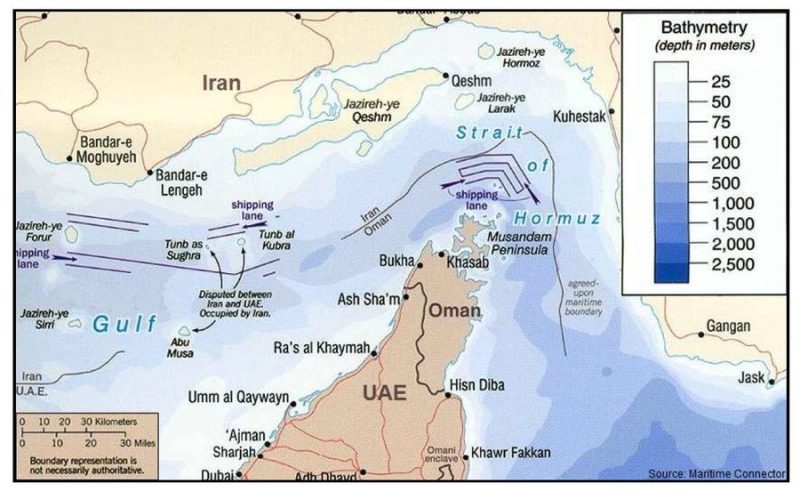
Iran put itself and the world into a bit of trouble with its actions in the Strait of Hormuz.
According to the NYT, the Iranians have no idea where some of their mines are located. How can they open the Strait with mines floating around. This is a nightmare for Iran and the numerous countries around the world that rely on the oil coming through that Strait.
Here’s more on the mines in the Strait of Hormuz:
The New York Times reported on April 10, citing US officials, that Iran has been unable to fully reopen the Strait of Hormuz because it cannot locate all of the naval mines it laid in the waterway and lacks the capability to remove them. The IRGC used small boats to plant mines haphazardly during the early weeks of the war. Many locations were never recorded. Some mines have drifted from their original positions. Iran does not have a complete map of what it put in its own water.
When Foreign Minister Araghchi said on April 8 that safe passage through Hormuz would be possible “with due consideration of technical limitations,” US officials now confirm he was not being diplomatic. He was being literal. The technical limitation is that Iran mined its own strait and lost track of where the mines are.
Iran published a chart on April 9 through Tasnim and ISNA showing a large circle marked “danger zone” covering the standard shipping lanes, with two alternative IRGC-controlled routes around Larak Island. This is the chart of a country directing traffic around its own weapons because it cannot guarantee the weapons will not detonate under the traffic it is trying to collect tolls from. The toll system, the IRGC coordination, the escort protocol, the VHF passcode, all the infrastructure built to monetize the chokepoint exists because Iran cannot simply reopen the chokepoint. The tollbooth is not leverage. The tollbooth is a workaround for a self-inflicted minefield.
Richard Meade, editor-in-chief of Lloyd’s List, described the situation during an April 10 webinar: “As of this morning, the Strait of Hormuz remains both open and closed, depending on your position, both geographically and geopolitically. It is, if you like, Schrödinger’s Strait.”
Traffic on April 10 stood at 7 to 18 ships per day, with only 2 to 4 tankers, against a pre-war baseline of roughly 140 daily. Over 1,000 vessels are queued outside the strait, including 187 tankers carrying an estimated 172 million barrels of stalled crude. The backlog alone would take weeks to clear even if every mine vanished overnight.
And the capacity to clear mines does not exist on either side. The US Navy decommissioned its last dedicated Avenger-class minesweepers before the war. It now relies on Littoral Combat Ship mine countermeasures modules that have never been tested at this scale. The Royal Navy withdrew its last mine countermeasures vessel, HMS Middleton, from the Gulf in early 2026 and transported it home on a heavy-lift ship because it could not make the voyage under its own power. The West dismantled its mine-clearing capability months before the war that required it.
Trump demanded “complete, immediate, and safe opening” of the strait as the ceasefire condition. Vance is flying to Islamabad to negotiate terms that require a physical outcome neither side can deliver. Iran cannot find the mines. The US cannot sweep them. The UK sent its last minesweeper home on a cargo ship. And the ceasefire that was supposed to reopen 20 percent of the world’s oil supply is hostage to weapons that are drifting silently through a strait that nobody fully controls.
The most honest phrase in the entire ceasefire was “technical limitations.” It just took the New York Times to decode what it meant. The mines are still there. The talks start tomorrow. And 20 percent of the world’s oil is waiting on a map that does not exist.
https://open.substack.com/pub/shanakaanslemperera/p/the-last-molecule-standing-3a7?r=6p7b5o&utm_medium=ios
The New York Times reported on April 10, citing US officials, that Iran has been unable to fully reopen the Strait of Hormuz because it cannot locate all of the naval mines it laid in the waterway and lacks the capability to remove them. The IRGC used small boats to plant mines… pic.twitter.com/Bzp5QXv63C
— Shanaka Anslem Perera ⚡ (@shanaka86) April 11, 2026