After Destroying Community College Education for Generations of Students – Can We Finally Get a Reset?
A Game, a Gateway — and What Happens After a Student Walks Through the Door
PART 4 – It Was Never Just About Football
If a student cannot afford the life required to walk through the college door and remain there long enough to finish — how affordable was the opportunity really? But affordability answers only part of the problem. An Affordable Door does very little good if a student sees no reason to walk through it. And that takes me all the way back to where this series began — sitting across a lunch table from John Crow, Ryan Caracciolo and Susan Winder, talking about junior-college football.
Somewhere during those three hours, I finally said what had been bothering me: “It isn’t just about football, is it?” It wasn’t… Football was beginning to look less like the destination and more like one possible doorway.
SO WHY DID THE DOOR CLOSE?
In February 2018, MCCCD announced that football would end after the fall season at Mesa, Scottsdale, Glendale, and Phoenix community colleges. The district’s publicly stated reasons were financial. At the time, MCCCD said the four football programs cost approximately $770,000 annually, consumed about 20 percent of the district’s athletics budget, accounted for more than half of certain related insurance costs, and could eventually require more than $20 million in capital improvements and associated expenses.
Those numbers cannot simply be ignored by anyone arguing that football should return. But neither should they automatically end the conversation. The question in 2026 is not whether MCCCD should simply recreate the program it operated in 2018. The question is whether a different model could be built — and whether its educational value would justify its cost.
That is essentially what the three candidates are proposing. Their campaign says football should return “responsibly, sustainably and with strong academic accountability.” Those are appealing words. Now comes the harder part:
What Would They Mean in Practice?
WHAT HAPPENED AFTER THE LIGHTS WENT OUT?
When football ended, MCCCD said nearly 350 student-athletes were affected. Contemporary reporting also said African-American students represented approximately 62 percent of the football players at the four colleges. That matters because the candidates have made Black male enrollment part of their argument for restoring football.
Their campaign says its analysis of federal enrollment data found an average decline of more than 31 percent in Black male enrollment across Arizona community colleges since the football programs disappeared. I still do not have the underlying spreadsheet or enough information to independently reproduce that calculation. So, I am treating the 31 percent as the campaign’s figure — not mine.
And there is another reason to be careful. Black male community-college enrollment was falling nationally during almost the same period. From fall 2019 through fall 2021, Black community-college enrollment declined 18 percent overall; among Black men, the decline was 23.5 percent, compared with 15 percent among Black women.
COVID clearly complicates the Arizona story. That means the numbers do not allow us to say that eliminating football caused the later decline in Black male enrollment. But they do establish something else.
So, the question worth asking is NOT: Did football cause everything that followed? The question IS: Did eliminating football remove one pathway into education at exactly the time some young men were becoming harder to reach?
That Question Is Still Open.
BRINGING FOOTBALL BACK IS NOT AS SIMPLE AS BUYING HELMETS
The historical $770,000 operating figure gives us a baseline. It does not tell us what restarting football would cost today. A modern restart would have to account for coaching and support staff, equipment, medical and athletic-training services, insurance, travel, facilities and whatever capital improvements would actually be required now.
There is also Title IX… Adding a large male football roster could significantly alter the balance of male and female athletic participation at an affected college. But Title IX does not impose a simple rule requiring one new female roster position for every male football player.
Federal law provides three different ways an institution may demonstrate that it is accommodating athletic interests and abilities: substantial proportionality; a history and continuing practice of program expansion for the underrepresented sex; or full and effective accommodation of that sex’s interests and abilities. A school need satisfy only one of those three tests.
So, Title IX is a real planning issue. It is not a one-for-one arithmetic formula.
And all of those questions have to be answered before the first team takes the field. Who pays the startup costs? How much comes from private fundraising or sponsorships? What expenses remain with taxpayers? What facilities are available? What happens if private revenue falls short? How will Title IX compliance be evaluated? And What measurable educational result will justify continuing the program five years later?
That Is Where Football Stops Being a Campaign Slogan, and Becomes a Governing Board Responsibility.
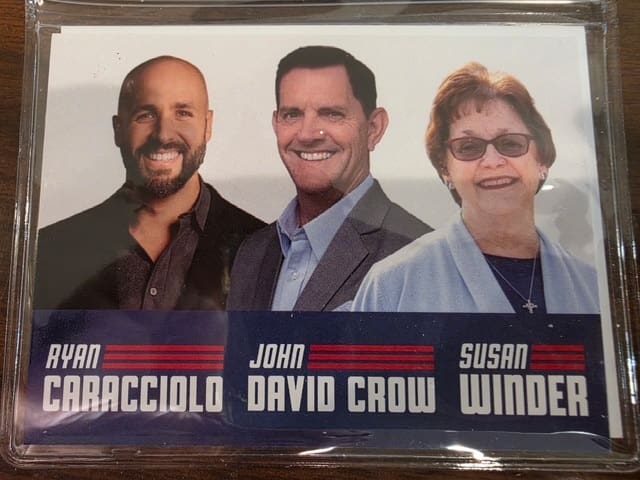
THREE CANDIDATES — THREE DIFFERENT QUESTIONS ABOUT THE SAME FOOTBALL FIELD
John Crow approaches the problem much the way he has approached other subjects during this series: What will it cost, who pays, and what results will we measure? He told me he is not proposing that MCCCD simply recreate the old program and absorb every expense. His proposal is a phased public-private model involving fundraising and sponsorships, use of existing community or high-school facilities where practical, transparent accounting, and measurable enrollment and retention goals.
Ryan Caracciolo looks at the same football field and sees enrollment, community engagement and growth. His proposal includes sponsorships, private fundraising, alumni support, partnerships, shared facilities and outside revenue — with enrollment, retention, academic progress, outside revenue and total costs tracked as measures of performance.
Susan Winder supports restoring JUCO football as well, but throughout our conversations her strongest emphasis has remained on what happens educationally once students arrive. In her follow-up answers, football was one of the things she said she would like addressed in her first year, alongside changes she wants examined in academics.
And there were those three lanes again…
John: Can we afford it and measure it?
Ryan: Can it attract students and help grow the system?
Susan: Once those students arrive, what are we teaching them, and what happens to them educationally?
None of those questions by itself answers whether football should return. Together, however, they explain why my original question changed.
THE GAME WAS NEVER THE WHOLE STORY
- A football field may bring one young man through the door.
- A nursing program may bring someone else.
- Another student may come for welding, electrical work, advanced manufacturing, healthcare, artificial intelligence, a six-week credential, an associate degree or even one of MCCCD’s newer four-year bachelor’s programs.
- A mother may come back because she needs another career.
- A veteran may come because military experience did not translate cleanly into civilian employment.
- And a student who never thought of himself as “college material” may discover that community college does not have to mean what he thought it meant.
That is why football finally made sense to me in a way it did not when I began this series.
The football program is NOT the education.
It may be the reason someone gives education a chance. And after that student walks through the door, everything we examined in the first three parts begins to matter.
- Is there an education worth staying for?
- Can the student afford the life required to finish it?
- Does the credential lead somewhere?
- Does the college measure whether the student succeeded — rather than simply whether the student enrolled?
And perhaps most important:
- Did That Student Leave with More Opportunity Than He Had When He Arrived?
That is the TEST — whether the doorway happens to be football, nursing, welding, a bachelor’s degree or something we have not imagined yet. We began this series asking:
Where did the students go?
What will bring them back?
Can they afford to stay?
And now, after four parts, we have come right back to that football field. Except now the answer to the question is different: A Football Field May Be a Doorway. But A Doorway Only Matters If It Leads Somewhere.
Because in the end: It was always about what might bring a student through the door; and what happens to that student once we get him there.
IT WAS NEVER JUST ABOUT FOOTBALL!
By Linda Brickman
©2026 Linda Brickman. All Rights Reserved.