
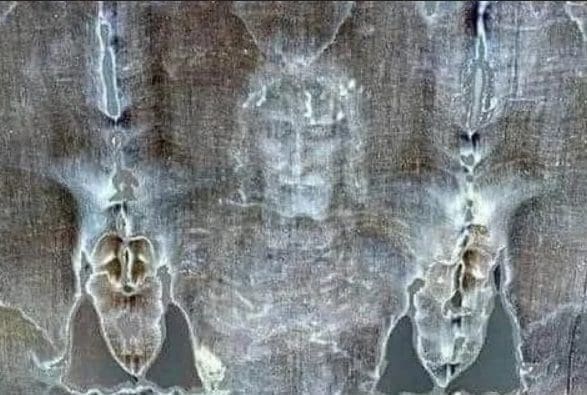
Is the Shroud of Turin the linen cloth Jesus was wrapped in after his crucifixion?
Some people have wanted to deny that the Shroud of Turin was the linen cloth that Jesus was buried in after his crucifixion. They have been trying to do so for 650 years or more. What is the truth?
According to The Archeologist new findings support the age old belief – this is the linen cloth Jesus was buried in:
The Shroud of Turin, a linen cloth revered by many as the burial shroud of Jesus Christ, has mystified scholars and believers alike for centuries. First unveiled in the 1350s, the shroud displays a faint image of a man, which has been the subject of intense debate regarding its origins and authenticity.
When it was initially presented, the Shroud was heralded as the actual burial cloth used to wrap the body of Christ after his crucifixion. The image on the shroud, depicting a bearded man with his arms crossed, was believed by many to be a miraculous imprint of Jesus himself. However, scientific research in the 1980s cast doubt on this claim, dating the fabric to the Middle Ages, long after Jesus lived.
Recent studies by Italian scientists, employing cutting-edge techniques involving x-rays, have reignited the debate by dating the shroud’s material to around 2,000 years ago, a timeline consistent with the era of Jesus. This finding supports the theory that the bloodstained pattern on the shroud could indeed have been left by Jesus’ body after his crucifixion.
According to the Bible, Joseph of Arimathea wrapped Jesus’ body in a linen shroud and placed it in a tomb. The Gospel of Matthew (27:59–60) details this event, which has been a cornerstone of Christian tradition. The Shroud of Turin, since its first public display in the 14th century, has fascinated historians, religious leaders, skeptics, and the faithful alike. It has been preserved in the Cathedral of San Giovanni Battista in Turin, Italy, since 1578.
The cloth itself reveals faint, brownish images of a gaunt man, standing between 5’7″ and 6′ tall, with markings that correspond to the crucifixion wounds described in the Bible, including thorn marks on the head, lacerations on the back, and bruises on the shoulders. These details align with the biblical account of Jesus’ suffering, suggesting that the man depicted on the shroud endured similar torture.
See the website the shroud for more.