
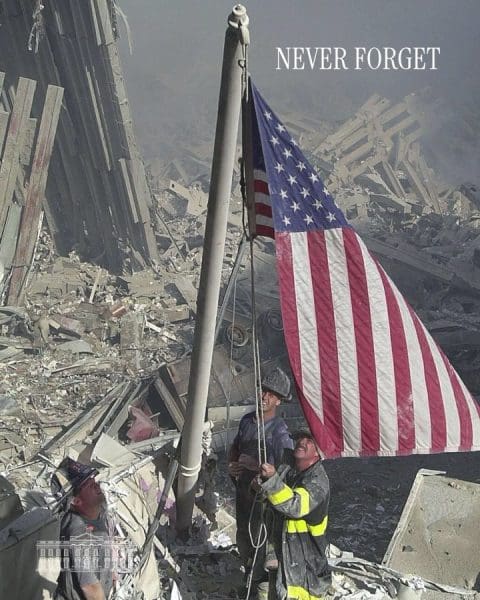
More Memories on 9-11
The White House shared the following:
A quarter of a century has passed since September 11, 2001, when the peace of our Nation was shattered by terrorists.
Today, we remember the 2,977 precious lives taken from us, honor the heroes who answered the call, & keep their families in the heart of our Nation.
Above all,… pic.twitter.com/krsBkfsdKi
— The White House (@WhiteHouse) September 11, 2026
Here’s another:
On the 24th anniversary of 9/11, we honor the lives lost, the heroes who emerged, and the resilience of the American spirit.
America will never forget. pic.twitter.com/FqV1MZNuG8
— The White House (@WhiteHouse) September 11, 2025
The far-left New York Times shared its unique take on today:
After an airliner hit the first tower, my dad rang. “Some idiot has flown a plane into the World Trade Center,” he told my roommate, who woke me up with the news. We were in our college dorm a few miles north of the site, and we figured it was a freak accident.
When the next plane struck, we knew it wasn’t. From our building, we could see the smoke column rising over Lower Manhattan. “All of us who were around then have our stories,” Dan Barry, who saw the plumes from a ferry that morning, writes in an elegy to “the memory of what you’d rather not remember.”
For our journalists, it was a hometown tragedy. The Times has chronicled every chapter of the 9/11 saga — the wars and their costs; the transformation of politics and culture and law and technology; the attackers and the victims.
On this 25th anniversary, reporters and critics are reflecting. Today, we offer a few ways to understand the meaning of 9/11.
Grief. It is famously not a thing you can pack away neatly with the passage of time. But I was moved by the story of Jacob Campbell, who was a 10-month-old baby when his mom died in the south tower. Sept. 11 haunted him into adulthood and drove him to booze, weed and suicidal thoughts. What brought him back from the brink? He realized what his grandparents had done in giving him a happy childhood. As he put it: “There are people out there who are in the midst of tragedy, and are helped. There is love in the world in equal measure to the suffering.”
Consequences. Many Americans joined the armed forces. We profile three whose service changed them. One 19-year-old became a machine gunner and eventually rose to squad leader in Iraq.
Today his right arm is wrapped in a black tattoo scattered with skulls — one for each person he killed in Ramadi. “Only two of them I regret,” he said. “One, I threw a hand grenade through a window, and it killed a 16-year-old boy. Another, we blew a door in not knowing Grandma was right on the other side.”
In New York, a wave of Islamophobia made neighbors suddenly suspicious of one another. Muslims in the city also became more politically engaged. A generation later, the city has a Muslim mayor whose efforts to observe the anniversary have not always been welcome.
Justice. Kenneth Feinberg had the strange job of deciding how much government money to award the surviving family members. He saw their pain up close. Some bridled at the idea that money could make them whole. A husband contemplating a $4 million payout snapped: “I got a better idea. Bring my wife back.” In this quiet portrait, Feinberg wonders whether a spiritual leader might have been better equipped for his task.
Normalcy. Listen to this terrific conversation between our critics Wesley Morris and Jason Zinoman about how 9/11 changed comedy. The weeks after the attack were awkward: On the return of “Saturday Night Live,” the NBC impresario Lorne Michaels asked Rudy Giuliani, “Can we be funny again?” The mayor’s reply: “Why start now?”
And this comes from the current mayor’s father.
This was written by the father of the current Mayor of New York.
25 years after 9/11, NYC has a leader whose family members have tried to normalize radical Muslim terrorist attacks.
Islam is not compatible with Western Civilization, this is evil. pic.twitter.com/30DlA2jgpO
— Benny Johnson (@bennyjohnson) September 11, 2026
Canada was a big help on Sept 11th. Check out what the town of Gander did to help.
The Diversion: On September 11, 2001, the United States closed its airspace after terrorist attacks.Planes Landing: Gander International Airport received 38 diverted international flights carrying nearly 7,000 passengers and crew.The Response: Gander had a population of around 10,000 people at the time. The town and surrounding communities opened their homes, schools, churches, and community halls to shelter, feed, and care for the stranded travelers for several days until U.S. airspace reopened.