
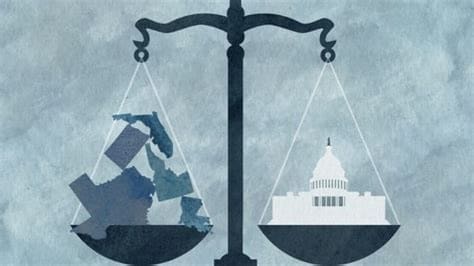
How Much Discretion Do States Have Under Federal Election Law?
Guest post by Linda Brickman
When election tools, voter data, State procedures, and Federal guardrails collide.
In the United States, election laws can look very different from one state to another. One State may allow same-day voter registration. Another may require earlier registration deadlines. One State may rely heavily on mail ballots. Another may impose stricter identification requirements. Some States participate in interstate data-sharing systems such as ERIC. Others have withdrawn or chosen different methods of maintaining voter rolls.
This article follows an earlier discussion of voter rolls and voter list maintenance. That article raised a larger question: if Federal law governs voter registration and election administration, why do State election procedures still differ so dramatically?
And that raises a simple but equally important question:
How much discretion do States actually have under Federal election law?
The answer begins with the U.S. Constitution. States have broad authority to administer elections, including the time, place, and manner of holding elections. That is why election procedures can vary so widely across the country. Arizona does not administer elections exactly like California. Texas does not operate exactly like Florida. Each state has its own laws, procedures, deadlines, databases, and election officials.
But State Authority is Not Unlimited.
Federal law creates guardrails. Congress has enacted laws such as the National Voter Registration Act of 1993, commonly known as the NVRA or Motor Voter Act, and the Help America Vote Act of 2002, known as HAVA. These laws do not make every state election system identical, but they do establish certain national standards for voter registration, voter list maintenance, statewide voter registration databases, and protections for eligible voters.
And that is where the debate begins.
Where does lawful discretion end, and where does legal conflict begin?
If Federal law sets the floor, how high may States build their own election systems above it?
- When does state discretion become innovation?
- And when does it create legal conflict?
- Or when does it undermine public confidence?
These questions matter because State election procedures directly affect voter rolls, ballot access, election security, transparency, and public trust. A State may claim it is expanding access. Critics may argue that the same policy weakens safeguards. A State may claim it is improving list maintenance. But critics may argue that the method raises privacy, accuracy, or political concerns.
ERIC is One Example.
The Electronic Registration Information Center was created as a data-sharing tool to help States identify voters who may have moved, died, or registered in more than one jurisdiction. Supporters describe ERIC as a useful method for improving voter-roll accuracy. Critics argue that ERIC raises serious concerns about governance, data sharing, outside influence, privacy, and its requirement that member states conduct outreach to eligible but unregistered individuals.
The ERIC debate is not only about one organization. It is part of a larger question: who should control the tools and data used in election administration?
Should States rely on interstate data-sharing organizations? Should voter-roll maintenance be handled entirely within State government? What level of transparency should be required when voter data is shared? What safeguards should exist before any outside system influences how election officials identify registration records for review?
Those questions are Not Theoretical…
In recent years, some States have remained in ERIC, while others have withdrawn and pursued alternative list-maintenance methods. That alone demonstrates how much discretion States still exercise within the Federal framework.
But discretion cuts both ways…
State flexibility allows States to respond to local needs, population changes, technology, voter behavior, and administrative challenges. At the same time, too much variation can leave citizens wondering why election procedures differ so dramatically depending on where they live.
And that is where Public Confidence enters the conversation.
Voters are often told that election laws are being followed. But many citizens do not know which laws apply, who enforces them, or where the line exists between State authority and Federal oversight. When that line becomes unclear, distrust grows.
The issue is not whether states have discretion. They do.
The issue is whether that discretion is being exercised transparently, lawfully, and in a manner that protects both election integrity and the rights of eligible voters.
States should not be treated as mere administrative branches of the Federal government. The Constitution gives them a central role in election administration. But neither should States be permitted to use discretion as a shield against accountability.
That is why citizens should be asking better questions:
- What does state law allow?
- Who is responsible for enforcement?
- What procedures are written in statute, and what procedures are created by administrative rule or election manual?
- When outside organizations, private vendors, or interstate data-sharing systems are involved, what transparency exists?
- And when a State’s election procedures appear to stretch beyond the public’s understanding of the law, who has the authority — and the courage — to challenge them?
Election integrity does not depend only on counting ballots. It depends on whether citizens can understand and trust the rules used before the first ballot is ever cast.
The real question is not whether States have discretion under Federal election law.
THEY DO!
The real question is: Where does lawful discretion end, and where does legal conflict begin?
Final Key Takeaways
✓ States have broad authority to administer elections, but that authority is not unlimited.
✓ Federal law creates guardrails through the Constitution, NVRA, HAVA, and other election-related statutes.
✓ Because States write and administer many of their own election procedures, election rules can vary dramatically from State to State.
✓ ERIC is one example of how an election administration tool can become a national debate over data, privacy, transparency, outside influence, and public trust.
✓ The question is not whether States have discretion. They do!
✓ The real question is where lawful discretion ends, and legal conflict begins.
✓ Citizens should not wait until Election Day to understand the rules. The laws, procedures, budgets, and legislative decisions made before an election often shape the election long before the first ballot is cast.
Endnotes
- S. Constitution, Article I, Section 4, Elections Clause.
- OJ NVRA List-maintenance guidance.
- HAVA statewide voter-registration database requirement, 52 U.S.C. § 21083.
- DOJ overview of the NVRA / Motor Voter Act.

© 2026 Linda Brickman. All rights Reserved.
censor their vote
Yes, yes, States can have their individual voting systems but the bigger issue is fraud and the Federal Government's authority to investigate it, prosecute offenders and nullify fraudulent elections -none of which is being done.
States ADMINISTER the election
Federal Government has every right to set the standards for voting in Federal Elections
States must administer their Federal elections to those standards or state disenfranchises their voters
Americans should all skip voting in Federal elections as it gives the fed gov the wrong idea that it can tax us to the hilt… Nevermind if ones still voting in federal elections now, ones too stupid to see its all FRAUD.
We don't have 'federal' elections. There has not ever been a 'federal' election in this Country.
We have only STATE elections for federal offices.
If YOU don't want a say in who is chosen to make our federal laws, that's YOUR choice.
It's VERY short-sighted, though.
You must be retarded. We have federal which are the elections for people in the federal government, we have state elections which people in the state vote for and we have county level elections which locals in the counties vote for.
You are part of the reason the CIRCUS exists with your retarded understanding of what you IMAGINE to be real.
They are all on the same ballot, genius, and it is the states that design, print, distribute, and count those ballots, so malfeasance or misfeasance of theirs affects candidates for federal offices.
Good point! They simply carry out the logistics of the voting, whereas the legal standards come from the fed, who needs to protect us from states that overrun other states (like calif)
States can set legal standards also.
They can,but they cannot set standards LOWER than the Federal standard.
Federal standards are often not authorized by the Constitution, and are therefore not valid. The SCOTUS is recognizing that.
States should be able to do anything they want with state and local elections, but when the vote involves a federal office all states must be the same. My humble opinion.
States have to follow the US Constitution regarding voting.
ALL voting amendments say voting is a Right of CITIZENS.
That means it's a CONSTITUTIONAL DUTY for the federal AND state govts to make laws ENSURING ONLY CITIZENS VOTE!!!
Your 'humble' opinion isn't based on all the facts.
The Constitution never says voting is a right of citizens. You are imagining that. Read it again and read it carefully.
You do know that the amendments are part of the Constitution, don’t you??
How many do you want me to cite? Here’s the 14thA Section 2:
“Representatives shall be apportioned among the several States according to their respective numbers, counting the whole number of persons in each State, excluding Indians not taxed. But when THE RIGHT TO VOTE at any election for the choice of electors for President and Vice-President of the United States, Representatives in Congress, the Executive and Judicial officers of a State, or the members of the Legislature thereof, is denied to any of the male inhabitants of such State, being twenty-one years of age,* AND CITIZENS OF THE UNITED STATES, or in any way abridged, except for participation in rebellion, or other crime, the basis of representation therein shall be reduced in the proportion which the number of such male citizens shall bear to the whole number of male citizens twenty-one years of age in such State.”
The very next amendment…
15thA
“Section 1.
The right of citizens of the United States to vote shall not be denied or abridged by the United States or by any State on account of race, color, or previous condition of servitude–
Section 2.
The Congress shall have power to enforce this article by appropriate legislation.”
And so on…
Guaranteeing citizens the right to votes is not the same thing as denying it to non-citizens.
Sure dude.
Whatever you say.
None of this will undo the steal California just did to Spencer Pratt…
When Ron DeSantis was elected Governor of FL by a few points, the first thing he did was fire the people who were on the shady side of elections. The rules were tightened up. When I got my FL license, I had to have my birth certificate, my military status, etc. to register to vote. When he ran for a second term, he won by 20 points. All votes were finished and counted at the end of election day. A lot of folks live in FL. California voting is a joke and is totally crooked like New Jersey. We will not maintain our standard of living if crooked voting is allowed.
NC does not used ERIC. The state voter rolls are filled with the dead, out of state and (of course) illegal aliens. Last "correction", brought by the US government, resulted in half a million being deleted from the voter rolls. Then the primaries had the dumb dims put 100,000 right back on the rolls.
States have as much discretion as the courts allow. The legislating from the bench has to stop.
The states have as much discretion as the Constitution allows.
State may have their digression when setting election laws, but when those laws act to subvert the reliability of an election, such as Mail-in ballots, or the unchecked registration of anyone with a pulse, then those laws can not be legal.
Is it the Federal Governments responsibility to investigate and prosecute election fraud? It should be if it isn't. If it is, the Government is not doing its job.
You left out the part about non-citizens prohibited from voting in federal elections. With millions of illegal aliens and other non-citizens roaming the country it is dumbfounding as to why states are not required to verify citizenship in order to vote.
In ALL elections!!!
Voting belongs to CITIZENS ONLY!!
Hilarious to see this clown Hoft getting behind the top down push of the fed gov to take over the nations states.
The States got together and formed the fed gov, the fed gov IS LESSER than the STATE GOVS. That they want to make it superior via Treason with Israel means the whole uniparty needs to be hung in the public square.
That's wrong. Do you not understand federalism???
The CONSTITUTION is SUPREME over ALL govts! The federal govt and state govts SPLIT supreme powers. The federal govt has some SUPREME powers and states have some SUPREME powers. The Constitution rules over everything.
ALL voting amendments say voting is a RIGHT of CITIZENS.
That imposes a CONSTITUTIONAL DUTY on ALL govts – federal, state, local – to ensure ONLY CITIZENS VOTE!
Incorrect there Spanky, LEARN YOUR HISTORY. The CONSTITUTION IS A LOAN AGREEMENT. Actual Americans stand under the Declaration of Independence. Your explanation makes clear that you Vote, being too stupid to see the forest thru the trees.
None of the amendments mention citizenship.
Back to school, DaRailer. Ever heard of the supremacy clause? Tired of your BS. Blocked.
California just enacted a law that prohibits any election official from turning over any voting materials to law enforcement. Sounds like they are trying to cement their ability to steal every election
CA regularly passes "Laws" that violate the Costitution and they dare anyone to do anything about it. And lookie… no one HAS!
Did I just read an IA generated article?? I feel a little violated.
MUCH more than they should have. The left have proven that given an inch of leeway they will take a mile of outright fraud.
DOJ says the CA cheating was all legal. It was all voted into law over about a 10 yr period. The communists use the constitution as a weapon. Everything they did was legal. They can only prosecute violations of federal law. Untill a suite is brought about violation of the Constitution. We here in CA are just f&$ked.
If a state's election fraud affects everything at the Federal level, then it matters to the whole country.
If a state's election fraud only affects the people living in that state, then it's the state's problem.
Several states have refused to hand over their federal election* records to the DOJ, including Colorado who politically imprisoned Tina for trying to investigate matters.
*If the election is for a national office like member of US Congress or US President, it is considered a "federal election." It's also why we have "federal election laws."
And why SoS, Jena Griswald should be in PRISON already.
Thanks to RINO Thune, they can do just about anything they want.
"The answer begins with the U.S. Constitution." — No. "The answer is ENTIRELY CONTAINED AND DEFINED in the u.S. Constitution."
"The answer begins with the U.S. Constitution." — No. "The answer is ENTIRELY CONTAINED AND DEFINED in the u.S. Constitution."
"The answer begins with the U.S. Constitution." — No. "The answer is ENTIRELY CONTAINED AND DEFINED in the u.S. Constitution."
"How Much Discretion Do States Have Under Federal Election Law?"
The correct answer is "zero," because federal law surpasses state and local laws.
State law surpasses federal law if the Constitution assigns that issue to the states. Under the Constitution states have rights that cannot be violated by the federal govt.
If you remember under the Bidet admin, States were required to follow federal law on a host of items, Eco-Suicide, D.I.E., immigration et al. But when the Rs are in charge, suddenly the (Blue)States demand their rights gain.
The federal govt often exceeds it’s constutional authority. Past actions do not create precedent for future violation.
One thing is for sure, they do NOT have the discretion to commit fraud !!!
States can only dictate the places for choosing senators. Everything else is dictated by the federal government. Trump needs to use existing laws to find, investigate, and fight the fraud.