
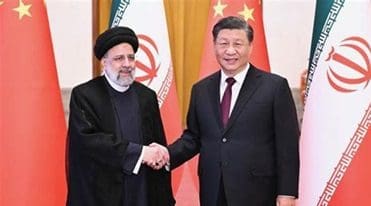
China Freezes All Iranian Money Held in China
President Trump got what he wanted during China’s visit to the US.
(The following is translated from Chinese.)
Iranian President Pezeshkian: All our money in China has been frozen.
We shipped our underground oil over there, tanker by tanker, only for the payment to be tightly withheld in their banks, not a single cent withdrawable. Even more dramatic is this: the one who spilled this humiliating affair to the world wasn’t some Western intelligence agency—it was the Iranian president himself.
During the UN General Assembly, Iranian President Pezeshkian sat down for an exclusive interview with Fox News anchor Bret Baier. Baier was pressing him on Iran’s funding of various armed groups in the Middle East, and Pezeshkian, eager to clear his name, poured out his grievances right there on live national TV: All our money in China has been frozen.
We can’t even get our money back from a country we supply,
let alone use it to pay people in other corners of the world.
The moment those words landed, the scene was nothing short of excruciatingly awkward.
For years, all sorts of propaganda had touted Iran and China’s local-currency settlements, their sidestepping of dollar sanctions, and an ironclad financial alliance.
So how, when it came time to settle the bill,
did a sitting head of state end up on a U.S. conservative network,
griping to Americans about his strategic partner holding the cash hostage?
So where exactly is this money stuck?
The knee-jerk reaction for many is: Did the Chinese side deliberately stiff them?
The reality is far colder and more brutal than any surface-level grudge.
At play here is a tightly interlocking one-way settlement dead end.
First, let’s look at how this oil gets sold in the first place.
Under harsh international sanctions, most of Iran’s daily crude production can’t enter legitimate global markets.
Over 90% of it ends up flowing to those independent refineries in Shandong, China—the so-called “teapot refineries.”
To evade tracking, the tanker fleets shut off their transponders in the Malacca Strait, transshipping the cargo multiple times on the high seas,
and each barrel sells at a bone-deep discount of $5 to $10.
The hard-won industrial lifeblood arrives,
but where does the buyer’s money go?
The money does get paid—but in RMB,
wired straight into designated accounts inside China, like Kunlun Bank, set up specifically for Iran trade.
On paper, up to this point, it’s all smiles:
You sell the oil, I pay up, and we dodge the dollar altogether.
But when Iran tries to pull that money out and use it,
that’s when the real headaches kick in.
Can Iran convert that pile of RMB into dollars or euros and wire it out?
In your dreams.
China’s major commercial banks hold trillions in global assets and operations—
who’d risk secondary sanctions from the U.S. Treasury’s Office of Foreign Assets Control just for one Iranian remittance?
Even Kunlun Bank, created back in the day for this very business,
tightened its risk controls after getting hammered by the U.S. Treasury in 2012 and cut off from dollar channels—
it flat-out refuses any cross-border settlements that might cross the red line.
Okay, so no dollars—could Iran just wire the RMB directly to Germany for industrial gear, or to Brazil for grain?
Still no dice.
Because Iran’s got a second chokehold: the blacklist from the Financial Action Task Force (FATF) on anti-money laundering.
Iran’s domestic stance—insisting on funneling cash to Hezbollah—
means they’ve stonewalled the UN’s anti-terrorism financing convention,
landing them alongside North Korea on FATF’s top-tier high-risk blacklist year after year.
Every legit bank in China has to follow international AML rules,
and for blacklisted countries, compliance teams run mandatory ironclad review processes.
A massive fund transfer from a Chinese account to a third country?
The bank’s compliance system auto-flags and blocks it on the spot.
That’s when things turn downright absurd.
Iran’s billions in accumulated oil revenue sitting in China
can’t be freely exchanged, can’t be wired across borders—
it’s physically morphed into an internal voucher redeemable only at select stores.
You either let it sit there depreciating on the books,
or you spend it on Chinese-made cars, appliances, construction machinery,
or overpay Chinese engineering crews to pave roads in Tehran.
If Iran desperately needs hard currency cash in a pinch, are there other options?
Only the underground hawaladars in Hong Kong and Dubai.
Middlemen layer it through dark web and shadow accounts,
each handoff siphoning off 15% to 20% in fees.
A barrel of crude dug up with blood and sweat,
hiked up with shipping costs, sold at a discount,
payment turning into an irretrievable voucher—
and if you finally want it as spendable cash, the money-laundering underworld carves off another 20%.
Back when Tehran triumphantly declared de-dollarization,
they thought escaping the dollar system meant charging into a free financial paradise.
Only to dive in and realize
the world’s rules never changed.
Ditching an open monetary system backed by rule of law and free convertibility
didn’t deliver independence or autonomy.
It trapped them in a one-way black hole that drains away tangible wealth and leaves behind a string of unwithdrawable digits.
In case you were wondering what Trump got out of his summit this week with Xi Jinping, check this out: China just froze all of Iran’s money there.
This is the same China that was buying 90% of Iran’s oil exports before Trump’s blockade.
It’s a new world, folks. https://t.co/WfB6JbKEBZ
— Rod D. Martin (@RodDMartin) September 26, 2026
I suspect Chinese troops are about to mobilize into Iran.